
- A Practice Built on Deliberate Choices
- Greyd.Suite as a Serious Part of the Toolkit
- Samir’s Burgers: Testing Ground, Feedback Loop, Community Resource
- An Honest Take on AI
- The Dream Project
- Watching Where WordPress Is Heading
- Training, Community, and Giving Something Back
- What Actually Makes Inesta Different
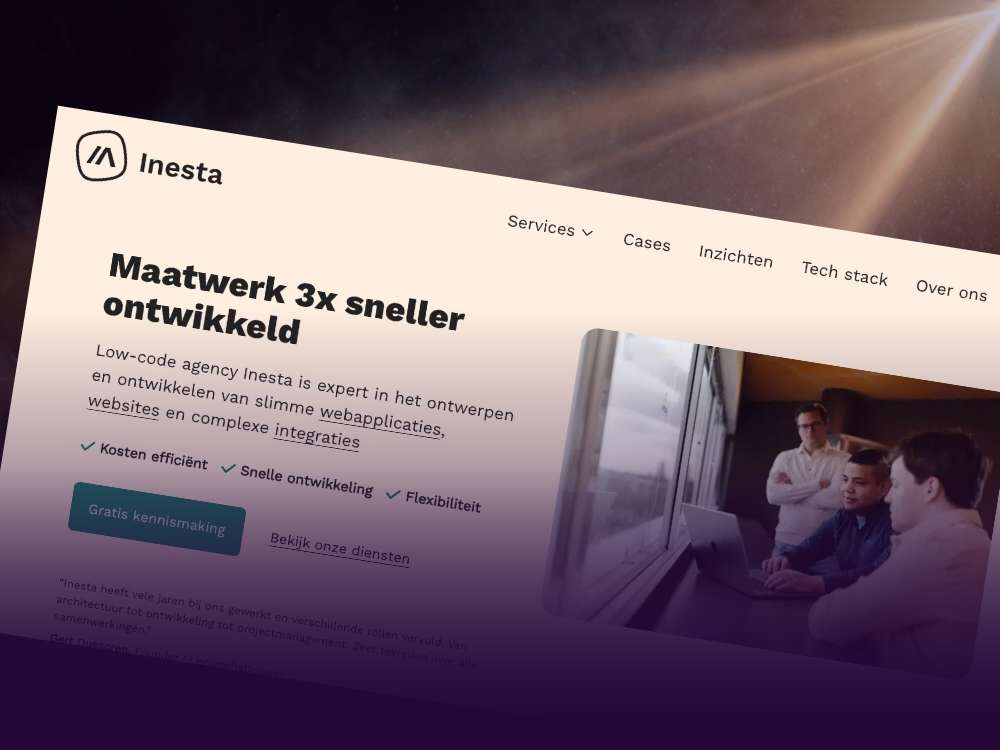
The Utrecht-based low-code agency from the Netherlands earned their spot on our partner page by building serious things with Greyd.Suite and knowing exactly what they are doing. Founder and CTO Roel Veldhuizen and front-end developer Samir Rafiq have been part of the Greyd.Suite community for a while, and we wanted to put them properly in the spotlight. They work in Dutch and English and serve both the Dutch and international market. I sat down with them to talk about how they work, what they have built, and where they are heading.
A Practice Built on Deliberate Choices
Some agencies go all-in on a single tool and sell that commitment as a philosophy. Inesta doesn’t. They have spent years building a practice defined not by loyalty to any particular stack, but by the discipline to match the right tool to the right problem. That combination, it turns out, is harder to find than it sounds.
They build web applications, websites, and complex integrations, and their client work ranges from a one-page starter site for a freelancer to a multisite enterprise setup with custom API connections.
Roel came to the agency through a handshake deal with its original founder, absorbing a book of clients that came with all the classic problems: outdated themes, plugin conflicts, sites that fell apart every time WordPress updated.
“We spent years moving away from all of that,” Roel said. “At a certain point we stopped building custom themes entirely. For most clients, a good page builder solved most of the problems. And now, for a growing number of projects, Greyd.Suite solves them better.”
Greyd.Suite as a Serious Part of the Toolkit
That last sentence matters more in context. Greyd.Suite is not where Inesta landed and stopped. It is an important part of a toolkit that still includes Gravity Forms, Polylang, Elementor, Beaver Builder, and custom code when a project genuinely needs it. What Greyd.Suite changed is the ceiling for what they can deliver without reaching for something else. Particularly when clients need a clean, fast site their own marketing team can actually manage. The block editor experience was one of the first things that convinced Samir.
“With previous page builders, you were always switching between editors,” he said. “With Greyd.Suite, you learn one editor and you use it for everything. Your pages, your blog posts, your custom post types. Clients notice the difference too. The backend is genuinely fast. That sounds like a small thing but it is the first thing they mention.”
One of the recurring frustrations with custom builds, Roel explained, was that marketers who had previously managed their own sites in tools like Elementor suddenly found themselves dependent on the agency for every small change. That friction was not acceptable to either side. Greyd.Suite shifted the balance back — fast enough for clients to stay in control, structured enough that things do not fall apart when they do.
When a project needs a custom integration that no plugin can handle cleanly, Roel writes it. That layered approach recently produced one of their most interesting builds: a multisite setup for Superp, an enterprise software consultancy company, using Greyd.Suite’s Global Content to manage shared content across two sites, combined with a custom integration connecting job applications directly to the recruitment platform Recruity.
Anne-Mieke: That kind of integration — is that something most agencies can actually deliver?
Roel: A lot of agencies offer this as a service. But what comes out is often not what the client expected. We can offer it with confidence because I know we can build that connection cleanly. It’s in our repository now, so we can use it again.
Samir: And for the client it just works. They publish once and it goes straight through to the recruitment system. That’s what they needed.
Global Content was the Greyd.Suite feature that made that architecture possible. Samir uses it regularly, both for syncing content across a multisite and for reusing blocks within a single site.
“I haven’t seen anything else that does what Global Content does,” he said. “It’s genuinely something that belongs to Greyd.Suite.”
Samir’s Burgers: Testing Ground, Feedback Loop, Community Resource
Samir does not just use Greyd.Suite on client projects. He also runs Samir’s Burgers, a personal demo and playground site that is itself a multisite with multilingual support via Polylang. It started as a way of testing what Greyd.Suite can do and showing the community what is already possible without significant time or cost investment. It has become more than that. While testing the Polylang combination, Samir found a bug and reported it to Greyd.Suite. At the time of our conversation, they had already picked it up and were working on a fix. That feedback loop, small as it sounds, is part of how Inesta engages with the products they work with. Tutorials are also in the pipeline, possibly on YouTube, though Samir is still working out which topics would be most genuinely useful.
Both of them are also watching the Greyd.Suite roadmap closely, and both are waiting for front-end forms with obvious impatience.
Samir: When that lands, clients will be able to publish content or submit forms directly from the front end, without ever going into the WordPress backend. That makes a real difference for them.
An Honest Take on AI
On the subject of AI, Roel and Samir were more candid than most.
“My feelings are mixed,” said Roel. “Sometimes it’s fast and the output is solid. But if you are not reviewing what comes out like a proper engineer, you are shipping tools that already carry serious technical debt before anyone has used them.”
Samir uses it with more precision. Specific scripts, targeted gaps, CSS solutions that would otherwise cost an afternoon.
Samir: I needed to place an image over a video and Greyd.Suite doesn’t offer that natively yet, so I wrote a small piece of code with AI assistance, checked it, made sure it’s dynamic and reusable, and it saves real time. I know what I’m asking for. That makes the difference.
Roel: That’s exactly it. A lot of people go to AI without knowing what they actually need, and they get something vague back. Then they come to us with that as if it’s research. We actually get worse briefings from people who ran their idea through AI first than from people who just called us directly.
The Dream Project
I asked them about their dream project deliberately. When I interview agencies, I want to know what they are genuinely hungry to build, not just what they have already delivered. The answer tells you more about where a team’s real capability sits than any portfolio page.
For Roel and Samir, the answer was a complex enterprise multisite with multiple external system integrations, full multilingual support, and Greyd.Suite used at a scale they have not yet had the chance to test properly.
Roel: There is a lot of potential in Greyd.Suite that we haven’t used yet. A project like that would be the chance to really flex our muscles at the level we know we’re capable of.
This is a technically grounded aspiration, coming from someone who already knows the platform well enough to know where its ceiling might be.
Watching Where WordPress Is Heading
Both Roel and Samir are paying close attention to how the tool landscape around WordPress is shifting. Bricks Builder established that there is a serious market for page builders aimed squarely at professional developers who really know their craft. Etch is doing something similar and both of them are watching it closely.
“Etch is the direct competitor to the Webflow interface,” said Roel. “That is not a small thing.”
I noticed the same pattern with Bricks Builder before Etch arrived. Tools that self-select for a more technical audience tend to push the entire ecosystem forward, because they raise expectations for what is possible. That is good for everyone building on WordPress, including the agencies and clients using Greyd.Suite.
Training, Community, and Giving Something Back
Training is becoming a growing part of what Inesta does. Samir spent years at a training institute teaching small business owners and freelancers to manage their own WordPress sites across tools including Elementor, Beaver Builder, and Gutenberg. That knowledge is now coming back into the agency as a structured offering: guided sessions where clients who do not need a full agency build can get set up properly and work independently from there.
“Some clients just need a one-pager and a handful of links,” said Roel. “We are not going to sell them three months of work. But we can make sure they start off the right way.“
Samir has also started appearing regularly on LinkedIn, where he occasionally offers to review websites publicly. It started as a casual idea. It has become a way of building authority while giving something back to the community that shaped a lot of how he works. An accessibility deep-dive session is also on the agenda, going further than automated checks, to sharpen what he looks for and why.
What Actually Makes Inesta Different
The through line across all of it, the client work, the training, the community presence, the product feedback, is that Inesta does not separate the technical from the strategic. Roel and Samir think about what a project needs, choose accordingly, and build with enough depth to be worth calling when something breaks.
That is a harder thing to describe in a portfolio than a single platform specialization. It is also considerably more useful. Agencies that combine genuine technical depth with the judgment to know when not to use it are rare. Inesta has spent twelve years proving that the combination is worth building on.
Learn more about Greyd.Suite!