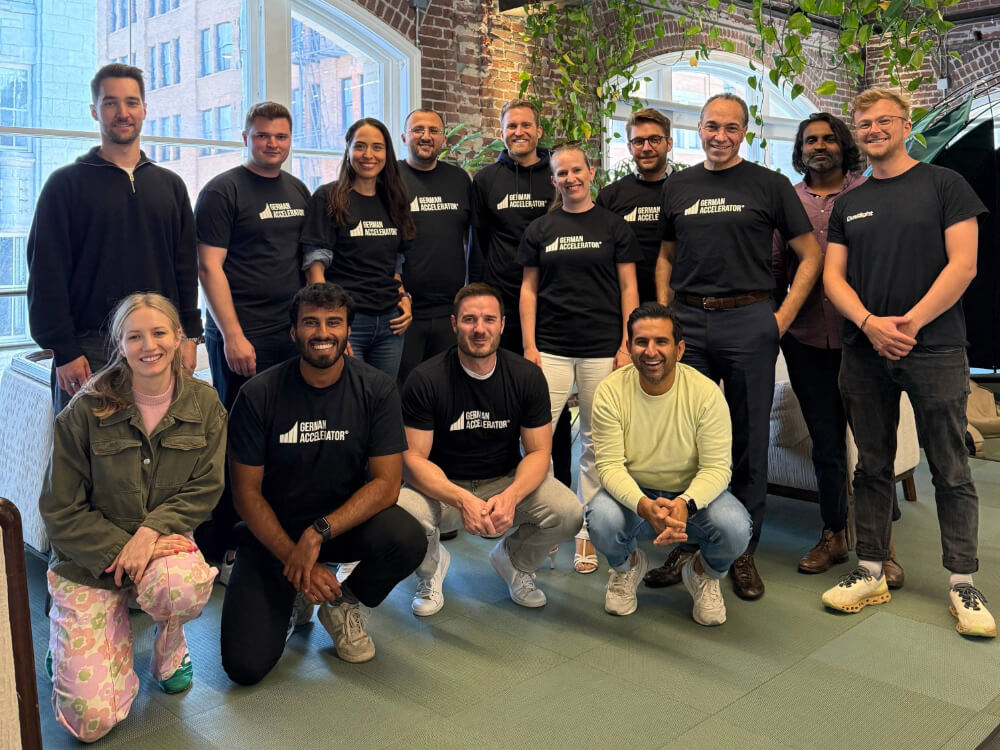

It’s a highly selective initiative backed by the Federal Ministry for Economic Affairs and Energy, designed to help startups like ours take our first serious steps toward entering the U.S. market. Being chosen is not just an honor, it’s a clear signal that what we’ve built has global potential.
When we talk about entering the U.S. market, it’s not about chasing buzzwords or posting feel-good updates from San Francisco. It’s about pressure, clarity, and tough strategic decisions. And that’s exactly what this first phase of the U.S. Market Access program has delivered.
We didn’t go to California for the sunshine. We came to put everything on the table. Our tech, our go-to-market, our pricing strategy, and tear it apart with people who’ve seen this before. People who don’t care how things work in Europe, because over here, the rules are different. Faster. Bigger. And brutally honest.
One of the first sessions we had, while still in Germany, was a deep-dive call with a group of experienced mentors. They’re real operators, most over 50, all with hard-earned scars. No fluff, no “nice deck,” just direct questions. Who’s your customer, really? What problem do you solve, in detail? How fast can you build momentum, and what’s in your way?
That’s where it got real
They told us straight: forget pricing for now. You can fix that later. What you need is momentum. Find the niche where you can win fastest. Cut the noise. Stop saying “universities, franchises, and agencies”, that’s too broad. Go deeper. Who exactly is making the buying decision? Are they tech-savvy? Do they operate nationally? What tools are they already using? What problem does Greyd solve for them right now, not in theory?
To me, this wasn’t a critique. It was a wake-up call. One that echoed something I’ve felt for a long time: we don’t have a lot of time or room for trial and error. The U.S. market is massive, and yes, chaotic, but it’s also incredibly structured if you know where to look. The structures match how Greyd works: scalable content, enterprise workflows, central governance. We’re not here to translate a European solution. We’re here to go all in, with eyes wide open.
Looking back, I can honestly say that if all we’d done was to have that one session, it already would’ve been worth it.
The reality check we needed
Once we arrived in Palo Alto, it became clear this wasn’t just another startup bootcamp. The German Accelerator team welcomed us with open arms and a schedule packed tighter than a San Francisco parking lot. The setting? Equal parts postcard and pressure cooker. A charming small-town vibe, yes, but every building you pass is a venture firm or a tech growth lab. Even the coffee shops feel like they’re one pitch deck away from a Series A.
Stanford was just down the road. And when I say “down the road,” I mean a sprawling innovation metropolis where you could probably fit every German university side by side and still have room left for a Tesla test track. Being surrounded by that much ambition has a strange effect: it reminds you how far you’ve come and how far you still have to go.
Bigger, faster, more brutally honest
German Accelerator surrounded us with seasoned mentors, many of whom had built and exited their own companies and weren’t afraid to be blunt. They’ve seen hundreds of SaaS startups pitch the American dream. They know what breaks a business before it scales.
One of the best parts of the program was the people. We met founders, mentors, and operators who’ve built serious companies, and were willing to share their hard-won lessons. They didn’t hold back and gave us exactly the kind of clarity we needed. These are the kind of people who don’t just talk about growth, they’ve lived it, and they push you to think sharper and aim higher.
The core message
The core message? Get focused. The U.S. market doesn’t reward vague. “Franchise,” for example, isn’t a customer, it’s ten buyer personas. We need to know who exactly we’re selling to, what keeps them up at night, and how Greyd solves that problem faster and more efficiently than anyone else.
That clarity is now our top priority. We’re sharpening our ICP, reworking our messaging, and building a go-to-market strategy that’s not just a repackaged European playbook. It’s a U.S.-native approach. One that considers not just what our product can do, but what our future customers need it to do, and how fast they expect to move.
We’ve already started working closely with our lead mentor, a no-nonsense founder with decades of experience in cloud and web technologies. He’s not there to pat us on the back. He’s there to push, challenge, and help us avoid wasting time on paths that won’t scale.
Show me the demo
What makes this program stand out is how unfiltered the insight is. Whether it’s go-to-market strategy, product demos, or U.S. incorporation logistics, nothing is sugarcoated. Demos, for example, are treated as critical sales tools, not tech showcases. You’re not just showing what your product does. You’re proving why someone should buy it. And that’s a skill in itself.
We learned what it really means to prepare for enterprise sales in the U.S.: different decision-makers with different motivations, all needing to see immediate value. Developers care about speed. Marketers care about flexibility. Procurement cares about ROI. The CEO wants strategic alignment. If your product messaging can’t speak to all of them, you’re not ready.
But what stood out most is the mentality. In the U.S., people are direct. They say what they think, make decisions fast, and respect action over polish. That mindset is contagious. It pushes you to cut the noise and get to work.
What’s next?
We’re currently deep in phase one, preparing for the final presentations in New York this October. From there, we’ll assess whether we apply for phase two of the program, which focuses heavily on sales execution.
Until then, we’re pushing full speed ahead, redefining our go-to-market strategy, aligning the entire team, and investing in the right conversations. Thanks to the incredible network around German Accelerator, we’ve gained access to mentors, investors, and operators who want us to succeed and who won’t let us settle for “good enough.”
We didn’t just go to California to work. We also soaked in the landscape, hiked the streets of San Francisco (which felt more like climbing the Alps), and got caught by a Pacific wave or two. But make no mistake, this trip was all business. A crash course in what it takes to win where the stakes are highest.
This isn’t about chasing hype. It’s about building real momentum, with real people, in a market that demands your best.
To be continued…
Want to learn more about Greyd.Suite?